Category Archives: lactofermented

Lacto-Fermented Garlic Paste

I’m lazy.  As my good friend Tricia told me this morning, I’m a super mom in some areas and lazy in others.  As I chatted with her in my pj’s amidst a super mess house, I peeled 4 lbs of garlic and bragged about how my 20 mo is fully potty trained, day and night.  Yeah, I’m awesome.

Sometimes I work hard so I can be lazy.  Like garlic paste.  I love fresh garlic and before I devoted my life to eating only real food, I bought garlic paste in the jar.  While it’s not horrible, it’s still not as good as the fresh stuff but sometimes I just too lazy to peel the clove, chop it up and then clean up the mess.  Sometimes I just want to open a jar and that’s it.  I can be that kind of lazy.  So when I’m feeling not lazy, I’ll make garlic paste.

This is what 4 lbs of garlic looks like.  Today I was feeling extra spunky and made 2 1/2 quarts of garlic (1 of garlic paste and 1 1/2 of pickled whole cloves).  How did I peel 4 lbs of garlic without going insane?  A while back a video was going around Facebook of a chef showing how he throws a whole head, just separating the cloves, in a large metal bowl, topping the bowl with another and shaking the crap out of it.  It works!  Love it!  I used 2 plastic bowls which worked but I think metal would be better.  Since plastic bends, it was hard keeping the skins from flying all over my kitchen.

Of course you don’t have to make a whole quart of it.  I’ve made a pint and even just a cup before.  Just divide the recipe accordingly.
I’m lucky enough to be friends with a gardener who specializes in garlic.  When she posted on Facebook that she still had a bunch from the end of the season, I jumped on it.  I kept the soft neck for fresh recipes and all the hard neck was lacto-fermented since it doesn’t keep as long.  You can use lacto-fermented garlic as you would regular garlic.  I prefer to not heat it up too much because you kill off all those wonderful probiotic buggies.  Add a small scoop to a cup of broth that has cooled enough to consume for a super yummy and healthy treat.  
Garlic is also wonderful this time of year to fight colds and the flu.  Mix a bit of garlic with honey, cayenne to kick strep.  It works!
Lacto-Fermented Garlic Paste
  • 1 pint worth of garlic (this might take upwards of 10 or so heads)
  • 2 tbsp fresh whey
  • 2 tsp sea salt
Place everything in a food processor and pulse until a smooth paste forms.  Scoop into a pint sized mason jar and using a spatula, clean the sides of the jar and press out any air pockets.  I’ll gently tap the jar on a padded surface to smooth it out and remove bubbles.  Let set at room temperature for 5-7 days and then move to cold storage.  I’ve heard garlic is best when aged a few months.  I wouldn’t know because we eat it too fast.  Maybe this time I’ll find out since I made so much.  

Brine Pickled Brussels Sprouts

I’ve been wanting to try this for a while.  Brussels sprouts are in the same family as cabbage so one would thing they would lend themselves well to fermenting.  
Brussels sprouts, peas and olives were the only foods I didn’t like as a child.  I’ve come to love olives, enjoy peas (not the frozen variety though), and Brussels sprouts were next on my list to conquer.  I’d been hesitant to try them again since the memory of the one time I had them as a child is burned into my mind as a very unpleasant experience.  But with my quirky palate, I always thought I should like Brussels sprouts.  Like olives, I think I just had a bad first experience.  I finally found a beautiful bunch that just called to me.  I tried frying 1 lb of them up using Jenny from the Nourished Kitchen’s recipe for Pan-Fried Brussels Sprouts with Piima Cream, and yes, they were wonderful.  Everything I thought they should  be.  
So of course next I wanted to try fermenting some.  Since this is my first time fermenting Brussels Sprouts, I’m keeping it simple.  I might play with flavors next time.

Brine Pickled Brussels Sprouts
  • 1lb Brussels Sprouts, rinsed and halved
  • 1 tbsp sea salt
  • 2 shallots, sliced thin
  • 1 tsp red pepper flakes, optional
  • 1/4 cup fresh whey (or an additional tbsp of salt)
  • filtered water
Layer Brussels sprouts, shallots and red pepper flakes.  Sprinkle salt and whey over the top and fill with filtered water to cover.  Shake jar gently to dissolve salt.  Let set at room temp for about a week.  Place in cold storage.


Brine Pickled Brussels Sprouts on Punk Domestics

Lactofermented Carrots with Indian Spices

I’m on an Indian kick.  Indian cuisine is just so flavorful, I couldn’t resist trying this spice mixture with carrots.  I’ve been waiting patiently for 5 days before cracking these open.  The rush of bubbles to the top tells me something has been at work over the last week and the smell is oh so yummy.  And the taste?  Even better than I expected!  I think this might be my favorite ferment yet.

Again I used baby carrots for this though I would love to try carrot spears or grated carrot with this spice combination.  Organic carrots can be hard to come by (except baby) in this area.  My order with Azure Standard was missing my organic carrots.  Boo!

Carrots with Indian Spices

  • 1 lb baby carrots (or grown-up carrots cut into spears)
  • 2 tsp mustard seeds
  • 2 tsp chili powder
  • 1″ knob of ginger, sliced
  • 2 garlic cloves, smashed
  • 1 tsp cumin
  • 1/2 tsp fenugreek
  • 1 tbsp sea salt
  • 1/4 cup fresh whey
  • Filtered water

Layer carrots and spices in a mason jar or fermentation crock.  Top with sea salt, whey and filtered water to cover. Shake jar to distribute spices and dissolve salt.  Cover loosely and leave at room temperature for 5-7 days then place in cold storage.

Part of Fight Back Friday and Fresh Bites Friday and Real Food Forager’s Probiotic Challenge


Indian Hot Lemons

Indian Cuisine is quite well known for it’s fermented foods. Chutneys, yogurts and all sorts of pickled vegetables abound. In this Hot Lemon Pickle recipe, I use traditional Indian spices with organic lemons and sea salt.  In my batch, I did use fresh whey to aid in the fermentation process but it is optional.  If you don’t use whey, throw in an extra tablespoon of sea salt.
Lemons and their juice can be used in recipes in place of regular lemons. You probably want to stick with Indian recipes with these ones or stuff a roasting chicken with them.  To maintain the benefit of the active cultures, add at the end and don’t heat more.  Try them in my Lemon Dhal recipe.  The peel on these lemons is actually the best part so slice it thin and garnish your lentils with it.  Enjoy!

Indian Hot Lemons

  • 2 lbs of organic lemons
  • 2 tsp turmeric
  • 1 tbsp red pepper flakes (more or less depending on your tolerance of spice)
  • 3″ knob of ginger, peeled and sliced
  • 4 tsp fenugreek
  • 4 tsp mustard seed
  • salt
  • 2 tbsp fresh whey

Quarter the lemons but don’t cut all the way through.  Leave lemon slices connected at the bottom.

Sprinkle a light layer sea salt in the bottom of mason jar.  Sprinkle salt inside each lemon, liberally.  Begin layering lemons, ginger and spices pounding with a wooden mallet, spoon or rolling pin.  One of these days I want to get a sauerkraut pounder.
  
You want to really mash them good, releasing the juice. Keep layering and pounding until the lemons are submerged in their own juice.  If you have trouble getting enough juice to cover them, you can add lemon juice. Top with 2 tbsp of fresh whey.
To keep them submerged, I placed the biggest lid I could fit inside the jar and then pushed it down with a smaller jar.

Let set at room temperature for 2 weeks then move to cold storage.

Curtido

Did you know there is a Mexican/Central American sauerkraut?  Curtido is a mix of carrot, onion, cabbage and spices.  This is my favorite way to enjoy fermented cabbage.  Jenny from the Nourished Kitchen introduced me to curtido last year through her Simple Meal Plans.  Each week she includes a lacto-fermented recipe in addition to 3 delicious meals, a dessert and a soup all using seasonal foods.

Curtido

  • 1 small head of cabbage, cored and shredded
  • 3 carrots, peeled and shredded
  • 1 small onion, shredded
  • 1 tsp crushed red pepper (or 1 jalapeno chopped)
  • 1/2 tsp cumin seeds
  • 1/4 cup fresh whey
  • 1 1/2 tsp sea salt
In a large non-reactive bowl, combine everything.  Mash together using a wooden spoon or or this masher from Cultures For Health.  You can also use your hands to really squeeze the juices out.  Once the juice is released from the vegetables, begin layering and pounding the mixture into a fermenting crock or mason jar.
Use a plate or a gallon sized Ziploc bag filled partway with water to keep the vegetable mixture submerged in it’s juices.  Let sit at room temperature for 2-4 weeks.  Mold may grow on top but just scoop it off.  After the ferment period, place in cold storage.  It will last a year or so.
This is my sauerkraut set up, a cheap glass jar from a craft store.  Once it’s done fermenting, I’ll put the curtido in quart sized mason jars so I can start another batch.  Maybe fermented lemons next…
This recipe is part of Fight Back Friday and Real Food Wednesday.

Pumpkin Cheesecake with Kefir

This simple recipe uses gelatin to set it rather than cooking.  You don’t want to cook all those good buggies in your kefir (or yogurt).  I love when tasty meets healthy.

Pumpkin Cheesecake with Nut Crust

  • 1 pkg unflavored gelatin
  • 1/2 cup water, divided
  • About 1 1/2 to 2 quarts of kefir or yogurt reduced to 2 cups kefir cheese (you can use 16 oz cream cheese), softened
  • 3/4 cup rapadura sugar (unprocessed sugar or honey)
  • juice 1 lemon (save zest for crust)
  • 1/2 cup fresh cream
  • 16 oz pumpkin (preferably fresh but canned will do)
  • 1 tsp cinnamon
  • 1/2 tsp ginger
  • 1/2 tsp nutmeg
  • pinch of salt

Dissolve gelatin in 1/4 cup cold water for about 5 mins.  Add 1/4 cup hot water and stir to dissolve.
In a stand mixer with a paddle, mix kefir until smooth.  Add sugar, lemon juice, cream, pumpkin, spices and salt. Whip for about 2 mins on medium speed.  Mix in gelatin until well blended.

Nut Crust

  • 1 1/2 cups almond flour
  • 5 tbsp melted butter (or coconut oil)
  • 2 tbsp rapadura sugar
Mix sugar into flour.  Mix butter until well blended.  Press into a deep pie plate.
Pour cheesecake mixture into the nut crust and chill overnight.

Labneh Kefir Cheese and Fresh Whey

Labneh kefir cheese is simply drained kefir.  This is how I get most of my fresh whey for all of my fermented fun experiments.  I like the idea that all the probiotic yumminess of kefir will be part of my fermented veggies.
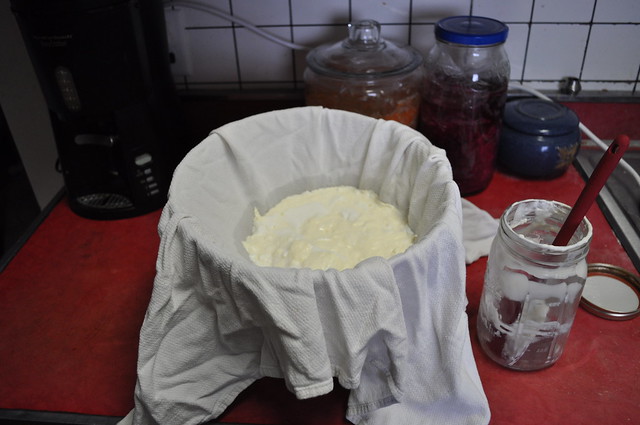
First line a colander with a thin towel.  I find a flat cloth diaper works excellent!  Place colander over a bowl and dump in your kefir.  Here I used a quart of kefir.  Let drip for about 8 hours or until kefir is the consistency of cream cheese.
Reserve the liquid whey.  It’s highly nutritious and can be used in lactofermentation, soaking grains/nuts/seeds or in baking.
Stay tuned for some recipes using Labneh.  I have a few ideas in mind…

Brine Pickled Radishes

I did say last week that I would be posting instructions for curtido but my laptop died…again.  I should have known better and immediately uploaded the pictures to Flickr but I didn’t.  So we’re doing Brine Pickled Radishes today.

Normally I try to ferment in season so I can have the vegetable out of season but I’m all out of radishes and have a hankering for them.  No, they do not grow in North Dakota in November.  Nothing grows in North Dakota in November.
Brine Pickled Radishes

2-3 bunches of radishes
1 tbsp salt
1/4 cup fresh whey
Spices, optional
filtered water
Trim and quarter the radishes.
Add spices (if using) to the a quart sized mason jar and then radishes, leaving about 1″ head space.  Sprinkle the salt and then the whey on top and add filter to cover radishes.  Cover jar tightly and give a shake to dissolve salt and mix spices.  Loosen the lid and let set in a warm place for 5-7 days.  
The red skin will bleed through the entire radish making them pink.  Love it!  I like to split the radishes into smaller jars so I can play with the spices.  The first is just radishes and garlic.  The second is radishes, garlic, and hot leftover chili seeds from making hot chili sauce.  The third is radishes, garlic and pickling spices.  My favorite are the spicy garlic radishes!

Red Cabbage Sauerkraut

Did you know sauerkraut is a fermented food?  Not the canned stuff you’ll find in the store though.  The canning process kills all the good bacteria you want.  This was one of my favorite “pickles” growing up but I don’t think I ever had the really good stuff.  Sauerkraut is the first fermented food I made (if you don’t count yogurt).  It is what made me fall in love with lacto-fermentation.

Here are instructions for the most basic sauerkraut.  Simple, yes, but oh so good!  Only 2 ingredients and just a little muscle.

  • 1 head of red cabbage, about 2-3lbs (or course green would work too)
  • 1 tbsp sea salt
First you’ll want to remove the outside leaves revealing a purple beauty.
Cut into quarters and chop out the core.
Now you can either shred the cabbage using a food processor (which I do) or you can chop up by hand.

Place cabbage in a large non-reactive bowl with the salt and mash the heck out of it.  I love this awesome wooden ladle from Paula Deen.  It can scoop and mash.  I wish it was a little smaller because it’s just barely too big to fit in a wide mouth mason jar.
Turn on a little music and pound away.  The cabbage will begin to release it’s juices.  Keep pounding until it’s nice and juicy.  
Start scooping some into your jar.  I’m using a half gallon recycled pickle jar here.  You can find some neat inexpensive glass jars at Hobby Lobby or Michael’s.  
Keep adding more cabbage and pounding it down.  When it’s all in, push the cabbage down so it’s submerged under that beautiful purple cabbage juice.
To keep the cabbage submerged, you can place a small plate on top with a weight or you can do what I do. Fill a bag with water and place on top.  I have a narrow jar so a quart sized bag works great.  For a crock, you’ll want a gallon sized bag.
Cover and set in a warm place in your kitchen for 1-4 weeks or longer depending on how sour you like your sauerkraut.  If you see mold, just scoop it off.  The sauerkraut is still good.  Once it’s fermented for however long you choose, place in cold storage for up to a year.
That’s Curtido fermenting in the background.  You’ll have to wait until next week to hear about Curtido…
So how do you use this wonderful fermented food?  Sauerkraut and sausage always go well together.  I also love it on top of salmon patties, hamburgers or just as a side.  I’m known to just serve myself a bowlful of sauerkraut as a snack.
This is what my 18 month old was doing while I was pounding away.
Goofball.

Lactofermented Purple Eggs!

In honor of our chickens finally starting to lay eggs, I tried making some lactofermented eggs this week. This is something I’ve been want to try for a while now.

They turned out beautifully! And they taste as good as they look.


Since I was unsure of the outcome, I only made 4 eggs which fit perfectly in a 1/2 quart jar (1/2 qt equals 2 cups or 1 pint, a little math lesson for you). Feel free to double this recipe for a full quart. I know I will!

4 hard boiled eggs
2 tsp sea salt
2 tbsp reserved liquid from lactofermented beets or fresh whey (for a darker egg, you can use up to 1/4 cup of juice)
Filtered water to cover
Stuff eggs in a 2 pint jar. Dissolve salt in the beet juice (add a little water if needed to dissolve salt). Add to jar. Add filtered water to cover eggs completely, leaving at least 1/2″ head space. Make sure eggs remain submerged and leave at room temperature for a day. Move to the fridge and let marinate for a few more days.
How to Boil Eggs
Since I’m amazed at how many don’t know how to hard boil eggs, here is how to get the perfect egg. The older the egg, the easier they peel. A 3 week old egg usually peels beautifully.
Fill a pot about 1/2 full of cool water, add as many eggs as you want (gently, you don’t want to crack them).
Set on the burner at medium heat. Too high of heat and the eggs will crack.
Bring to a gentle boil.
As soon as the water begins to boil, remove from the heat, cover and set the timer for 10 minutes (6 mins for a soft boiled egg).
Once the timer goes off, gently drain off the water and start running cold water over them. You can add ice to make them cool faster if you would like. If you let them sit too long, the yolk will start to turn green and get rubbery.


Design a site like this with WordPress.com
Get started