Category Archives: GAPS

Counter Top Yogurts

I was talking with my mother-in-law (who is eager to make some diet changes, yay!) about yogurt and probiotics and while I say making yogurt is easy, I have to admit for someone completely new to traditional cooking, it can be quite daunting.  But that doesn’t mean you shouldn’t try it!  I’m going to show you how to make the simplest of yogurts, no special equipment required.

Yogurt is what happens when you add certain beneficial bacteria to milk and allow it to culture for a few hours to a day.  The longer the fermentation period, the more sour it is.  The bacteria eat the lactose so if left to culture long enough, all the lactose will be spent and those who are lactose intolerant should be able to enjoy yogurt without later regret.  The yogurt that most of us is familiar from the store contains lactobacillius acidophilus and bifidobacteria and is cultured at 110F for just a few hours.  But did you know there are many different kinds of yogurt?  A yogurt from a different part of the world may contain different strains of bacteria and some do not need the higher temps of the store bought yogurt we are all familiar with.

I use 3 different types of counter top yogurts: Villi, piima, and kefir.

Viili and Piima
Viili and piima (yes, there are 2 i’s) originated in Scandinavia and cultures between 70-78F.  they have thinner consistency that what you may be familiar with but it lends itself very nicely to smoothies and has a nice mild taste.  I actually prefer their taste over store bought yogurt.

Kiddo loves it with just a few drops of stevia to sweeten.  Now that’s a milk mustache!

They are actually quite simple to make.  No joke.  To make either viili or piima, you simply gently mix in 1/4 cup of starter per 1 quart of milk, loosely cover and leave it alone for 12-24 hours.  24 hours will ensure all the lactose is eaten up.  If you are using raw milk, you’ll want to maintain a special starter about once a week.  I just warm up 1 quart of milk to 160F and then let it cool to room temperature and add 1/4 cup of starter from a previous batch.  Raw milk contains bacteria and while it is good bacteria, it will contaminate the yogurt culture and you might get some funky results if you don’t maintain a pure starter.  

You can purchase viili and piima (and many other different yogurts) at Cultures for Health.

Kefir
Now kefir is a bit different than other yogurts in that it is these gelatinous masses (grains) that create the kefir yogurt that is mildly effervescent.  Milk soda?  It is a symbiotic matrix of beneficial yeasts and bacteria.  It is much more diverse than yogurt and contains incredible amount of different yeasts and bacterial.  All good for a healthy gut.  You can find a list of bacteria and yeasts that can be found in kefir here: http://www.culturesforhealth.com/milk-kefir-grains-composition-bacteria-yeast

My favorite thing about kefir is not only the complexity of it but the simplicity of making it.  Just drop the grains in a quart of milk and it does all the work.  Come back the next day and you have kefir.  Strain the kefir out (I just fish them out with a spoon and rinse them off gently) and add to a new quart of milk.  My family goes through a quart a day easily but if you don’t need a quart every day, you can let your kefir rest by placing it in cold water or milk and refrigerating it for about a week.  If you need to take a break from kefir, you can freeze it for a few months just fine.

Kefir also multiplies so you can either just eat the extra or you can give some to a friend.  To get your own kefir grains, if you don’t have a friend with some, Cultures for Health also carries kefir grains.

Make your own sour cream!
All three of these cultures also make the best sour cream.  You’ll never need to buy sour cream again!  Just add 1/4 cup piima, viili or kefir grains per quart (or 1 tbsp per cup) and let it set 12-24 hours. Be sure to use farm fresh cream if it’s available.  If not, be sure to NOT use ultra-pasteurized cream.  Only fresh or pasteurized works well.
Oooh, you must try making butter out of this cultured cream.  Super yumminess!  Hmm, I may have to write a whole separate post for this goodie.

How to use viili, piima and kefir?


Our favorite way to eat yogurt is to just add a few drops of stevia or raw honey to sweeten and maybe a few drops of vanilla or orange extract.  You can make a quick and easy smoothie by blending in some fresh juice (like Naked Juice) or frozen berries.  I like the ratio of 2 parts yogurt, 1 part juice.  It also gets used in place of buttermilk, yogurt and sour cream in recipes.  Drip it for yogurt cheese, cream cheese or to use in Pumpkin Cheesecake.

*Just a note.  I do have an affiliation with Cultures for Health but have been recommending them long before the affiliation.  I get all of my cultures from here and highly recommend them. I’d never recommend anything that I didn’t stand behind.


Eggs for Breakfast

When I say we usually have eggs for breakfast I don’t mean just plain eggs.  We make all sorts of good eggs!  Eggs are the best way to save money while eating real.  Here we can get a dozen eggs from pastured hens for $2.50 a dozen and with a family of 6, we can burn through 4 dozen easily in a week.  Not just for breakfast but in smoothies for added nutrition and we love quiche and egg bakes.

I’m all about quick and easy.  I hear people say they don’t have time for eggs in the morning but it only takes a few more minutes than pouring a bowl of cereal and it’s so much better and more satisfying than cardboard cereal.  Protein is what kids need to pay attention.  I’d love to see a study comparing how well kids concentrate after having a carbohydrate loaded breakfast verses a high protein breakfast (know of one?).

I’ll give you two of my favorite recipes.  Feel free to experiment with different cheeses and spices.  Eggs can be fun!

Cheesy Scramble Eggs
  • Butter to coat pan
  • 4 eggs
  • 1/4 cup shredded cheese (cheddar, swiss, experiment with different kinds)
  • 1/4 tsp crushed red pepper or Italian herbs or Mexican spices (optional)
Melt butter in cast iron skillet.  Beat 4 eggs and add to a medium hot cast iron skillet.  Stir in cheese and pepper.  Gently stir and flip to keep from burning but don’t stir too much.  You want them nice and fluffy.  The cheese makes these eggs the fluffiest!

Eggs over easy (medium or hard, you’re choice), with Spinach and Feta

  • 2 tbsp butter
  • 2 eggs from pastured hens
  • about 8 oz spinach
  • Feta, crumbled (or shredded cheese of your choice)
  • Hot chili sauce, optional

Melt butter in cast iron skillet.  Wilt the spinach and set aside (cover to keep warm).  Cook eggs as desired.  Just remember, a gooey yoke is better for you.  Top spinach with eggs, sprinkle feta and chili sauce.  Yum!


Pumpkin Cheesecake with Kefir

This simple recipe uses gelatin to set it rather than cooking.  You don’t want to cook all those good buggies in your kefir (or yogurt).  I love when tasty meets healthy.

Pumpkin Cheesecake with Nut Crust

  • 1 pkg unflavored gelatin
  • 1/2 cup water, divided
  • About 1 1/2 to 2 quarts of kefir or yogurt reduced to 2 cups kefir cheese (you can use 16 oz cream cheese), softened
  • 3/4 cup rapadura sugar (unprocessed sugar or honey)
  • juice 1 lemon (save zest for crust)
  • 1/2 cup fresh cream
  • 16 oz pumpkin (preferably fresh but canned will do)
  • 1 tsp cinnamon
  • 1/2 tsp ginger
  • 1/2 tsp nutmeg
  • pinch of salt

Dissolve gelatin in 1/4 cup cold water for about 5 mins.  Add 1/4 cup hot water and stir to dissolve.
In a stand mixer with a paddle, mix kefir until smooth.  Add sugar, lemon juice, cream, pumpkin, spices and salt. Whip for about 2 mins on medium speed.  Mix in gelatin until well blended.

Nut Crust

  • 1 1/2 cups almond flour
  • 5 tbsp melted butter (or coconut oil)
  • 2 tbsp rapadura sugar
Mix sugar into flour.  Mix butter until well blended.  Press into a deep pie plate.
Pour cheesecake mixture into the nut crust and chill overnight.

Apple Cinnamon Grain Free Granola

Amazing!  This is my favorite cereal yet.  Even the kids like it!  They haven’t been too thrilled with all the nuts I put in the grain free granola but they are warming up to it.  I love how filling this cereal is.  My husband filled a bowl like he did in the past with his normal cereal.  I just laughed and said, “You’re not going to be able to eat all that.”  He ended up sharing it with two of our kids.

Soaking your nuts and grains overnight helps remove some of the phytic acid, an anti-nutrient.  For this recipe, I used less coconut and more nuts than my last.  I didn’t increase the sweetener because my homemade applesauce was very sweet.  You can taste your cereal before baking to get the sweetness level right for you.

Apple Cinnamon Grain Free Granola

  • 16oz almond slices
  • 1 cup sunflower seeds
Cover with water and 1 tbsp salt and let set overnight.  Drain.
  • 2 cups coconut, shredded and unsweetened
  • 1/2 cup coconut oil (or butter), melted
  • 1/2 cup honey
  • 1 cup applesauce 
  • 1 tbsp cinnamon
  • 1/4 tsp salt
Heat oven to 200F.  Combine nuts and remaining ingredients, mixing well to combine.  Line 2 sheet pans with parchment paper and granola spread evenly.  Let bake for several hours, 4-6.  Stir occasionally and break up large pieces.
Serve with milk or yogurt.  I like to sprinkle a small handful of golden raisins and a tablespoon of ground flaxseed in my cereal.

Labneh Kefir Cheese and Fresh Whey

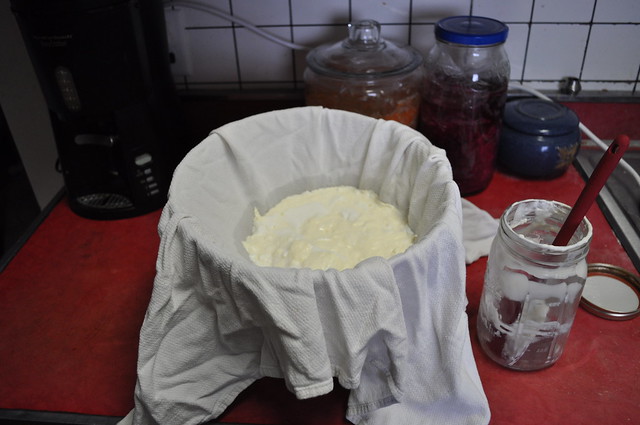
Labneh kefir cheese is simply drained kefir.  This is how I get most of my fresh whey for all of my fermented fun experiments.  I like the idea that all the probiotic yumminess of kefir will be part of my fermented veggies.
First line a colander with a thin towel.  I find a flat cloth diaper works excellent!  Place colander over a bowl and dump in your kefir.  Here I used a quart of kefir.  Let drip for about 8 hours or until kefir is the consistency of cream cheese.
Reserve the liquid whey.  It’s highly nutritious and can be used in lactofermentation, soaking grains/nuts/seeds or in baking.
Stay tuned for some recipes using Labneh.  I have a few ideas in mind…

Brine Pickled Radishes

I did say last week that I would be posting instructions for curtido but my laptop died…again.  I should have known better and immediately uploaded the pictures to Flickr but I didn’t.  So we’re doing Brine Pickled Radishes today.

Normally I try to ferment in season so I can have the vegetable out of season but I’m all out of radishes and have a hankering for them.  No, they do not grow in North Dakota in November.  Nothing grows in North Dakota in November.
Brine Pickled Radishes

2-3 bunches of radishes
1 tbsp salt
1/4 cup fresh whey
Spices, optional
filtered water
Trim and quarter the radishes.
Add spices (if using) to the a quart sized mason jar and then radishes, leaving about 1″ head space.  Sprinkle the salt and then the whey on top and add filter to cover radishes.  Cover jar tightly and give a shake to dissolve salt and mix spices.  Loosen the lid and let set in a warm place for 5-7 days.  
The red skin will bleed through the entire radish making them pink.  Love it!  I like to split the radishes into smaller jars so I can play with the spices.  The first is just radishes and garlic.  The second is radishes, garlic, and hot leftover chili seeds from making hot chili sauce.  The third is radishes, garlic and pickling spices.  My favorite are the spicy garlic radishes!

Red Cabbage Sauerkraut

Did you know sauerkraut is a fermented food?  Not the canned stuff you’ll find in the store though.  The canning process kills all the good bacteria you want.  This was one of my favorite “pickles” growing up but I don’t think I ever had the really good stuff.  Sauerkraut is the first fermented food I made (if you don’t count yogurt).  It is what made me fall in love with lacto-fermentation.

Here are instructions for the most basic sauerkraut.  Simple, yes, but oh so good!  Only 2 ingredients and just a little muscle.

  • 1 head of red cabbage, about 2-3lbs (or course green would work too)
  • 1 tbsp sea salt
First you’ll want to remove the outside leaves revealing a purple beauty.
Cut into quarters and chop out the core.
Now you can either shred the cabbage using a food processor (which I do) or you can chop up by hand.

Place cabbage in a large non-reactive bowl with the salt and mash the heck out of it.  I love this awesome wooden ladle from Paula Deen.  It can scoop and mash.  I wish it was a little smaller because it’s just barely too big to fit in a wide mouth mason jar.
Turn on a little music and pound away.  The cabbage will begin to release it’s juices.  Keep pounding until it’s nice and juicy.  
Start scooping some into your jar.  I’m using a half gallon recycled pickle jar here.  You can find some neat inexpensive glass jars at Hobby Lobby or Michael’s.  
Keep adding more cabbage and pounding it down.  When it’s all in, push the cabbage down so it’s submerged under that beautiful purple cabbage juice.
To keep the cabbage submerged, you can place a small plate on top with a weight or you can do what I do. Fill a bag with water and place on top.  I have a narrow jar so a quart sized bag works great.  For a crock, you’ll want a gallon sized bag.
Cover and set in a warm place in your kitchen for 1-4 weeks or longer depending on how sour you like your sauerkraut.  If you see mold, just scoop it off.  The sauerkraut is still good.  Once it’s fermented for however long you choose, place in cold storage for up to a year.
That’s Curtido fermenting in the background.  You’ll have to wait until next week to hear about Curtido…
So how do you use this wonderful fermented food?  Sauerkraut and sausage always go well together.  I also love it on top of salmon patties, hamburgers or just as a side.  I’m known to just serve myself a bowlful of sauerkraut as a snack.
This is what my 18 month old was doing while I was pounding away.
Goofball.

Grain Free Granola

You read that right.  Grain free granola.  No wheat, no oats, no barley flakes, no grain period.  This turned out better than I imagined.  I thought I would have to play around with ratios before posting the recipe but I got a winner on the first try.  I’ll still play around because it’s fun creating different recipes.  In this recipe, you soak the nuts and seeds overnight.  Why do that?  Nuts, seeds and grains contain phytic acid which is an anti-nutrient and enzyme inhibitors.  For more info on that, Cheeseslave.com has some great articles.  I’d start here http://www.cheeseslave.com/2009/11/17/why-soak-and-sprout-grains/  It does take a little extra planning but it’s worth it.


Grain Free “Granola”
  • 1 cup chopped walnuts 
  • 1 cup raw sunflower seeds
  • 4 cups shredded coconut, unsweetened
  • 1/2 cup coconut oil (or butter)
  • 3/4 cup honey
  • 1 tbsp cinnamon
  • 1 tbsp vanilla
  • 1/2 cup dried fruit (I used chopped sulfur free apricots)
Soak walnuts and sunflower seeds in enough water to cover with 2 tsp sea salt overnight.  Or if you have a supply of crispy nuts from Nourishing Traditions, you can use those and skip the soaking step.
Mix nuts, seeds and coconut.  In a saucepan, warm up coconut oil with honey, cinnamon and vanilla.  Mix oil/honey mixture with nuts, seeds and coconut. Stir to coat well. 
Divide mixture between 2 baking sheets (line with parchment for easy cleaning).  Heat oven to 200F and bake for about 4-6 hours, stirring occasionally.  When the nuts are dry, it’s ready.  Let cool then add dry fruit.  

Cream of Carrot Soup

Nothing hits the spot like a warm creamy soup on a snowy winter day.  We’re experiencing our first snow of the season today but all is well here.  I’m cuddled on the couch with my sleeping toddler, my knitting nearby and a bowl of soup.  Perfect.

I actually made this soup on accident. I was just boiling up some carrots in chicken stock (we’re doing the GAPS intro diet right now).  I thought it would be yummy pureed into a soup and I couldn’t resist a big dollop of cream.  So good!  Only 4 ingredients so it doesn’t get easier than this.

Cream of Carrot Soup

  • 1 quart chicken stock
  • 8 medium carrots, roughly chopped
  • 1 tsp sea salt (or to taste)
  • sour cream (I culture my own farm fresh cream with kefir grains or piima culture)
Place stock and carrots in a medium saucepan and bring to a boil. Simmer for about 30 mins or until the carrots are very soft.  Remove from heat and puree with an immersion blender right in the pot or in a blender. Add salt to taste.  Serve with a generous dollop of sour cream.
This also tastes great if you add a bit of leftover shredded chicken or beef pot roast and a splash of hot chili sauce.

Part of Sunday Night Soup Night.


Lactofermented Purple Eggs!

In honor of our chickens finally starting to lay eggs, I tried making some lactofermented eggs this week. This is something I’ve been want to try for a while now.

They turned out beautifully! And they taste as good as they look.


Since I was unsure of the outcome, I only made 4 eggs which fit perfectly in a 1/2 quart jar (1/2 qt equals 2 cups or 1 pint, a little math lesson for you). Feel free to double this recipe for a full quart. I know I will!

4 hard boiled eggs
2 tsp sea salt
2 tbsp reserved liquid from lactofermented beets or fresh whey (for a darker egg, you can use up to 1/4 cup of juice)
Filtered water to cover
Stuff eggs in a 2 pint jar. Dissolve salt in the beet juice (add a little water if needed to dissolve salt). Add to jar. Add filtered water to cover eggs completely, leaving at least 1/2″ head space. Make sure eggs remain submerged and leave at room temperature for a day. Move to the fridge and let marinate for a few more days.
How to Boil Eggs
Since I’m amazed at how many don’t know how to hard boil eggs, here is how to get the perfect egg. The older the egg, the easier they peel. A 3 week old egg usually peels beautifully.
Fill a pot about 1/2 full of cool water, add as many eggs as you want (gently, you don’t want to crack them).
Set on the burner at medium heat. Too high of heat and the eggs will crack.
Bring to a gentle boil.
As soon as the water begins to boil, remove from the heat, cover and set the timer for 10 minutes (6 mins for a soft boiled egg).
Once the timer goes off, gently drain off the water and start running cold water over them. You can add ice to make them cool faster if you would like. If you let them sit too long, the yolk will start to turn green and get rubbery.


Design a site like this with WordPress.com
Get started