Monthly Archives: November 2011

Counter Top Yogurts

I was talking with my mother-in-law (who is eager to make some diet changes, yay!) about yogurt and probiotics and while I say making yogurt is easy, I have to admit for someone completely new to traditional cooking, it can be quite daunting.  But that doesn’t mean you shouldn’t try it!  I’m going to show you how to make the simplest of yogurts, no special equipment required.

Yogurt is what happens when you add certain beneficial bacteria to milk and allow it to culture for a few hours to a day.  The longer the fermentation period, the more sour it is.  The bacteria eat the lactose so if left to culture long enough, all the lactose will be spent and those who are lactose intolerant should be able to enjoy yogurt without later regret.  The yogurt that most of us is familiar from the store contains lactobacillius acidophilus and bifidobacteria and is cultured at 110F for just a few hours.  But did you know there are many different kinds of yogurt?  A yogurt from a different part of the world may contain different strains of bacteria and some do not need the higher temps of the store bought yogurt we are all familiar with.

I use 3 different types of counter top yogurts: Villi, piima, and kefir.

Viili and Piima
Viili and piima (yes, there are 2 i’s) originated in Scandinavia and cultures between 70-78F.  they have thinner consistency that what you may be familiar with but it lends itself very nicely to smoothies and has a nice mild taste.  I actually prefer their taste over store bought yogurt.

Kiddo loves it with just a few drops of stevia to sweeten.  Now that’s a milk mustache!

They are actually quite simple to make.  No joke.  To make either viili or piima, you simply gently mix in 1/4 cup of starter per 1 quart of milk, loosely cover and leave it alone for 12-24 hours.  24 hours will ensure all the lactose is eaten up.  If you are using raw milk, you’ll want to maintain a special starter about once a week.  I just warm up 1 quart of milk to 160F and then let it cool to room temperature and add 1/4 cup of starter from a previous batch.  Raw milk contains bacteria and while it is good bacteria, it will contaminate the yogurt culture and you might get some funky results if you don’t maintain a pure starter.  

You can purchase viili and piima (and many other different yogurts) at Cultures for Health.

Kefir
Now kefir is a bit different than other yogurts in that it is these gelatinous masses (grains) that create the kefir yogurt that is mildly effervescent.  Milk soda?  It is a symbiotic matrix of beneficial yeasts and bacteria.  It is much more diverse than yogurt and contains incredible amount of different yeasts and bacterial.  All good for a healthy gut.  You can find a list of bacteria and yeasts that can be found in kefir here: http://www.culturesforhealth.com/milk-kefir-grains-composition-bacteria-yeast

My favorite thing about kefir is not only the complexity of it but the simplicity of making it.  Just drop the grains in a quart of milk and it does all the work.  Come back the next day and you have kefir.  Strain the kefir out (I just fish them out with a spoon and rinse them off gently) and add to a new quart of milk.  My family goes through a quart a day easily but if you don’t need a quart every day, you can let your kefir rest by placing it in cold water or milk and refrigerating it for about a week.  If you need to take a break from kefir, you can freeze it for a few months just fine.

Kefir also multiplies so you can either just eat the extra or you can give some to a friend.  To get your own kefir grains, if you don’t have a friend with some, Cultures for Health also carries kefir grains.

Make your own sour cream!
All three of these cultures also make the best sour cream.  You’ll never need to buy sour cream again!  Just add 1/4 cup piima, viili or kefir grains per quart (or 1 tbsp per cup) and let it set 12-24 hours. Be sure to use farm fresh cream if it’s available.  If not, be sure to NOT use ultra-pasteurized cream.  Only fresh or pasteurized works well.
Oooh, you must try making butter out of this cultured cream.  Super yumminess!  Hmm, I may have to write a whole separate post for this goodie.

How to use viili, piima and kefir?


Our favorite way to eat yogurt is to just add a few drops of stevia or raw honey to sweeten and maybe a few drops of vanilla or orange extract.  You can make a quick and easy smoothie by blending in some fresh juice (like Naked Juice) or frozen berries.  I like the ratio of 2 parts yogurt, 1 part juice.  It also gets used in place of buttermilk, yogurt and sour cream in recipes.  Drip it for yogurt cheese, cream cheese or to use in Pumpkin Cheesecake.

*Just a note.  I do have an affiliation with Cultures for Health but have been recommending them long before the affiliation.  I get all of my cultures from here and highly recommend them. I’d never recommend anything that I didn’t stand behind.


Eggs for Breakfast

When I say we usually have eggs for breakfast I don’t mean just plain eggs.  We make all sorts of good eggs!  Eggs are the best way to save money while eating real.  Here we can get a dozen eggs from pastured hens for $2.50 a dozen and with a family of 6, we can burn through 4 dozen easily in a week.  Not just for breakfast but in smoothies for added nutrition and we love quiche and egg bakes.

I’m all about quick and easy.  I hear people say they don’t have time for eggs in the morning but it only takes a few more minutes than pouring a bowl of cereal and it’s so much better and more satisfying than cardboard cereal.  Protein is what kids need to pay attention.  I’d love to see a study comparing how well kids concentrate after having a carbohydrate loaded breakfast verses a high protein breakfast (know of one?).

I’ll give you two of my favorite recipes.  Feel free to experiment with different cheeses and spices.  Eggs can be fun!

Cheesy Scramble Eggs
  • Butter to coat pan
  • 4 eggs
  • 1/4 cup shredded cheese (cheddar, swiss, experiment with different kinds)
  • 1/4 tsp crushed red pepper or Italian herbs or Mexican spices (optional)
Melt butter in cast iron skillet.  Beat 4 eggs and add to a medium hot cast iron skillet.  Stir in cheese and pepper.  Gently stir and flip to keep from burning but don’t stir too much.  You want them nice and fluffy.  The cheese makes these eggs the fluffiest!

Eggs over easy (medium or hard, you’re choice), with Spinach and Feta

  • 2 tbsp butter
  • 2 eggs from pastured hens
  • about 8 oz spinach
  • Feta, crumbled (or shredded cheese of your choice)
  • Hot chili sauce, optional

Melt butter in cast iron skillet.  Wilt the spinach and set aside (cover to keep warm).  Cook eggs as desired.  Just remember, a gooey yoke is better for you.  Top spinach with eggs, sprinkle feta and chili sauce.  Yum!


Pumpkin Cheesecake with Kefir

This simple recipe uses gelatin to set it rather than cooking.  You don’t want to cook all those good buggies in your kefir (or yogurt).  I love when tasty meets healthy.

Pumpkin Cheesecake with Nut Crust

  • 1 pkg unflavored gelatin
  • 1/2 cup water, divided
  • About 1 1/2 to 2 quarts of kefir or yogurt reduced to 2 cups kefir cheese (you can use 16 oz cream cheese), softened
  • 3/4 cup rapadura sugar (unprocessed sugar or honey)
  • juice 1 lemon (save zest for crust)
  • 1/2 cup fresh cream
  • 16 oz pumpkin (preferably fresh but canned will do)
  • 1 tsp cinnamon
  • 1/2 tsp ginger
  • 1/2 tsp nutmeg
  • pinch of salt

Dissolve gelatin in 1/4 cup cold water for about 5 mins.  Add 1/4 cup hot water and stir to dissolve.
In a stand mixer with a paddle, mix kefir until smooth.  Add sugar, lemon juice, cream, pumpkin, spices and salt. Whip for about 2 mins on medium speed.  Mix in gelatin until well blended.

Nut Crust

  • 1 1/2 cups almond flour
  • 5 tbsp melted butter (or coconut oil)
  • 2 tbsp rapadura sugar
Mix sugar into flour.  Mix butter until well blended.  Press into a deep pie plate.
Pour cheesecake mixture into the nut crust and chill overnight.

Apple Cinnamon Grain Free Granola

Amazing!  This is my favorite cereal yet.  Even the kids like it!  They haven’t been too thrilled with all the nuts I put in the grain free granola but they are warming up to it.  I love how filling this cereal is.  My husband filled a bowl like he did in the past with his normal cereal.  I just laughed and said, “You’re not going to be able to eat all that.”  He ended up sharing it with two of our kids.

Soaking your nuts and grains overnight helps remove some of the phytic acid, an anti-nutrient.  For this recipe, I used less coconut and more nuts than my last.  I didn’t increase the sweetener because my homemade applesauce was very sweet.  You can taste your cereal before baking to get the sweetness level right for you.

Apple Cinnamon Grain Free Granola

  • 16oz almond slices
  • 1 cup sunflower seeds
Cover with water and 1 tbsp salt and let set overnight.  Drain.
  • 2 cups coconut, shredded and unsweetened
  • 1/2 cup coconut oil (or butter), melted
  • 1/2 cup honey
  • 1 cup applesauce 
  • 1 tbsp cinnamon
  • 1/4 tsp salt
Heat oven to 200F.  Combine nuts and remaining ingredients, mixing well to combine.  Line 2 sheet pans with parchment paper and granola spread evenly.  Let bake for several hours, 4-6.  Stir occasionally and break up large pieces.
Serve with milk or yogurt.  I like to sprinkle a small handful of golden raisins and a tablespoon of ground flaxseed in my cereal.

What are we feeding our kids?

Today we have a guest post by my wonderful step-mother, Cathy Finnesgard.

Trick or Treat

Here’s a little gem I picked up from the trick-or-treat basket at work—Halloween fruit snacks. Yum! What do you suppose is in them? Fruit, do you think?

Maybe…
Would you consider them a healthy treat for your kids?
Let’s see…

I see fruit juice as the first ingredient (apple, pear). Then corn syrup AND sugar. What’s that at the bottom? White mineral oil? MINERAL OIL? Is that food? And what’s that next ingredient? Wax? But, there’s an asterisk pointing to a possible concern… it adds just a trivial amount of fat. Oh, I feel much better now. I was really worried my child might get too much fat, because fat is so dangerous, you know. But no, only mineral oil and wax – probably not enough to hurt anyone…provided, of course, the child eats only one little packet. What about two packets? What about two packets every other day? But don’t worry, there’s essentially NO fat, and that’s the biggest thing, after all. And they promise “freshness and quality.” Whew! I was worried there for a minute.

Let’s look at mineral oil just for kicks. It’s used in the candy to keep the pieces from sticking together. You can actually feel the oil on the surface of the pieces. Mineral oil is liquid petroleum. It is a byproduct of the distillation of petroleum in the process of making gasoline and other products from crude oil. It is not a food; it is considered a drug when taken internally. Mineral oil is used to treat constipation. It coats the intestinal surface so that water isn’t absorbed into the body. Due to this property it also interferes with the body’s ability to absorb vitamins and other nutrients from food. So, how much of that vitamin C they infuse into this product do you think your child will actually absorb?

Now what about the carnauba wax? Not to worry, it’s made from a plant. That makes it okay, I suppose, right? From About.com, “Carnauba wax consists of fatty acid esters (80-85%), fatty alcohols (10-16%), acids (3-6%) and hydrocarbons (1-3%). It is around 20% esterified fatty diols, 10% methoxylated or hydroxylated cinnamic acid, and 6% hydroxylated fatty acids. Carnauba wax has a very high melting point of …180-187 °F. It is harder than concrete and nearly insoluble in water and ethanol.” (Did you follow all that? Even the spell-checker had trouble with half those words.) But, don’t worry—it’s non-toxic and hypoallergenic—and you can eat it, apparently. Here are some of its uses: furniture and car wax, cosmetics, the coating on dental floss, and the coating on candy (helps with that hard shiny coat, like you find on M&Ms). I’m not sure what it’s doing in gummy-chewy “treats” like these, but we can be 100% sure of its freshness and quality.

What’s the lesson in all this? There are 17 (at least) ingredients in this little 80-calorie bag of mysterious processed chemicals masquerading as food.

Why not just eat the apple? Your body knows what to do with the apple.

Cathy Finnesgard
November 8, 2011


Labneh Kefir Cheese and Fresh Whey

Labneh kefir cheese is simply drained kefir.  This is how I get most of my fresh whey for all of my fermented fun experiments.  I like the idea that all the probiotic yumminess of kefir will be part of my fermented veggies.
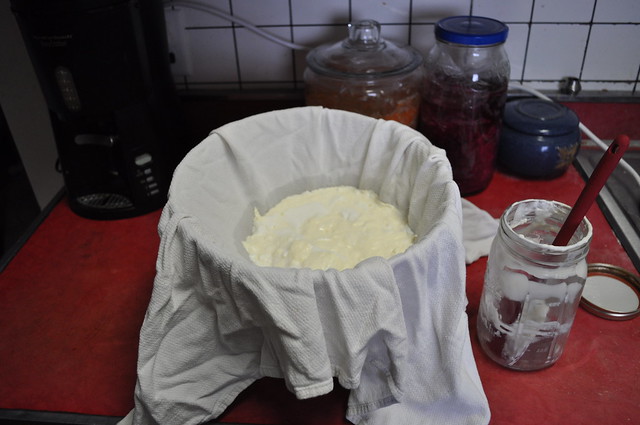
First line a colander with a thin towel.  I find a flat cloth diaper works excellent!  Place colander over a bowl and dump in your kefir.  Here I used a quart of kefir.  Let drip for about 8 hours or until kefir is the consistency of cream cheese.
Reserve the liquid whey.  It’s highly nutritious and can be used in lactofermentation, soaking grains/nuts/seeds or in baking.
Stay tuned for some recipes using Labneh.  I have a few ideas in mind…

Chocolate Eggnog

I wanted hot chocolate tonight but as I started gathering the ingredients to make some, I thought chocolate eggnog would be super tasty.  So I made that instead.  Good idea!  This is not only super tasty and easy to make but it’s good for you too!

Chocolate Eggnog

  • 4 cups cold raw milk
  • 1/2 cup cocoa powder
  • 1/3 cup hot water
  • 4 eggs
  • 2 tbsp honey or maple syrup
  • 2 tsp vanilla
  • 1/2 tsp cinnamon
  • 1/4 tsp nutmeg
Mix cocoa powder, honey and hot water until smooth.  Let cool a bit.  Using an immersion blender, regular blender or mixer, add remaining ingredients and blend until smooth.  Enjoy!
*Next time I think I’ll replace one cup of milk with one cup of fresh cream (I was out).

Thanksgiving Menu

Today I’ll be working on our Thanksgiving menu.  I think I’ll be doing things a bit simpler this year because I want to spend time with my family not in the kitchen.  I’ll also be making as much as I can ahead of time.  We’re not having any guests, just my husband and the 4 kids.  So I started looking through my menu last year, remember how good everything was, and thought I would share that with you.

  • Turkey:  I made a simple Spice Butter from Martha Stewart rubbed on the turkey and roasted at 325F until thermometer reads 180F.  It was amazing!
  • Green Beans:  Instead of a green bean casserole, I made Balsamic Green Beans with Roasted Red Peppers.  This year I plan on making this with my lacto-fermented red peppers added at the end so the probiotic yumminess isn’t destroyed by too much heat.
  • Pumpkin:  Instead of pumpkin pie, this Pumpkin Custard from the Nourished Kitchen was great.  
  • Mashed Potatoes:  Another goodie from the Nourished Kitchen, Herbed Buttermilk Mashed Potatoes.
  • Stuffing:  Beef, Celery, Walnut and Apple “Stuffing”.  This grain free paleo recipe rocked my socks!  I was so surprised at how delicious it was.  A-ma-zing.
  • Cranberry Relish:  I can’t find the original recipe I used last year but it was very similar to this Cranberry Relish, subbing honey for sugar and real mandarin oranges for canned ones.
Come to think of it, I may just do this menu again.  It was awesome…why reinvent the wheel?


Brine Pickled Radishes

I did say last week that I would be posting instructions for curtido but my laptop died…again.  I should have known better and immediately uploaded the pictures to Flickr but I didn’t.  So we’re doing Brine Pickled Radishes today.

Normally I try to ferment in season so I can have the vegetable out of season but I’m all out of radishes and have a hankering for them.  No, they do not grow in North Dakota in November.  Nothing grows in North Dakota in November.
Brine Pickled Radishes

2-3 bunches of radishes
1 tbsp salt
1/4 cup fresh whey
Spices, optional
filtered water
Trim and quarter the radishes.
Add spices (if using) to the a quart sized mason jar and then radishes, leaving about 1″ head space.  Sprinkle the salt and then the whey on top and add filter to cover radishes.  Cover jar tightly and give a shake to dissolve salt and mix spices.  Loosen the lid and let set in a warm place for 5-7 days.  
The red skin will bleed through the entire radish making them pink.  Love it!  I like to split the radishes into smaller jars so I can play with the spices.  The first is just radishes and garlic.  The second is radishes, garlic, and hot leftover chili seeds from making hot chili sauce.  The third is radishes, garlic and pickling spices.  My favorite are the spicy garlic radishes!

Our Journey with Autism

Reblogging from my old personal blog:

I’ve had quite a few people asking me about autism, ADHD and diet recently so I thought a blog post would be appropriate.
This is one of the main reasons I’m as obsessed with nutrition as I am.  I’ve seen first hand the drastic effect diet can have on behavior.  (This is the only digital picture I could find near the time of his diagnosis)
  image from i155.photobucket.com
Almost 8 years ago, our oldest son (referred to as A#1 in all my posts), was diagnosed with autism shortly before he turned 3.  We were noticing signs from the time he was a small baby but being first time parents, we didn’t realize they were signs.  The first sign was lack of eye contact.  We just thought it was funny how he would do everything in his power to not look at us when we were holding him.  My mom said we should mention it to the doctor but I didn’t see why.  I had no idea that lack of eye contact was a sign for anything.  He was slow to talk, but I’m not a big talker myself so I just thought I didn’t talk to him enough.  By the time he was 2 with only a couple words and lots of jibberish, we were getting concerned.  I was especially concerned because he seemed to not understand us at all either.  I knew babies comprehension was usually larger than their expressive language.  My mom again told us we should mention it to the doctor, but I still didn’t didn’t believe something was wrong.
And the obsessions!  When people would tell me their child was obsessed with something like cars, I would laugh and say they had no idea what obsession was.  My child was obsessed.  Fans, wheels, washing machines (basically anything that spun), electrical outlets and phones.  Oy the phones!  We actually had to lock our phone in a kitchen cabinet out of his reach to keep him from calling people at age 2.  We had “time and temp” programmed into the phone so he could “talk” to someone when no one else was available.
The breaking point was a conversation my sister had with my uncle’s sister, a special ed teacher who worked mostly with autistic children.  We had been to a birthday party at my aunt and uncle’s house where Barb was able to interact with A#1.  She spotted the signs right away.  God bless her for saying something to my sister.  My sister very gently let me know what Barb had said so I finally had the kick in the butt to make some phone calls.  I had no idea that autism had many different faces, not just the face of Dustin Hoffman in Rain Man.
So now we’ll jump forward a few months after confirming with a child clinical psychologist and early childhood experts with the school, high functioning autism.  Here I need to thank my mom and Uncle Munch for instilling basic nutrition facts in me from the start.  My mom used the Feingold diet with us kids when we were small so I was well aware of the fact that diet can affect behavior.  The first thing I did with Alex was start researching diet and autism.  I was already aware of the gluten/casein connection but knew there had to be more.
I stumbled upon the SCD (specific carbohydrate diet) and it seemed to be the answer.  I purchased the book, “Breaking the Vicious Cycle” and immediately changed his diet.  Basically you remove anything that takes effort for you body to digest.  Protein and monosaccharides are what you can eat.  Meat, nuts, properly cultured dairy only, cooked fruits and veggies, that’s it.  No grains, no startches.  The key to a diet like this is to focus on what you can have and not what you can’t.  While it may seem restrictive, it’s incredibly healthy.  To make it easier on Alex, the whole family ate this way for the most part (we’d sneak forbidden foods when he was sleeping).  For 2 years he ate this way.  We noticed within months of starting the diet, his vocabulary increased exponentially.  His activity level was more on the level of other boys his age, he could handle change better and better, hand flapping disappeared, obsessions… well, that’s about the only thing we still deal with.  He’s spinning my salad spinner right now as I’m writting this.  But salad spinners are pretty cool…
We were on the strict SCD for 2 years and slowly worked over to a modified gluten free/casein free diet.  Sugar is very strictly limited, no soy and limited grains as well.  He seems to do totally fine on unpasteurized cow milk (it’s interesting that we tolerate unpasteurized but not pasteurized).  We also follow the Weston Price Foundation guidelines of eating real foods: Meats, eggs and milk fed on pasture; cod liver oil and sunlight; lots of fresh veggies; bone broths; lacto-fermented foods, yogurt and all sorts of probiotics.  We’ve gotten to the point where if he gets wheat on accident, he’s fine but I still won’t add it back into our diet as a regular guest.  Maybe at some point I’ll be ready to try soaked/sprouted wheat or true sourdough bread, but I’m still scared of gluten.
DSC_0003
Recently I came across and new diet called GAPS (gut and psychology syndrome) diet.  From what I understand, it’s like a mix of the SCD and the Weston A. Price Foundation principles.  This is the diet I point people to now.  http://www.gapsdiet.com
http://rcm.amazon.com/e/cm?t=adoraknits-20&o=1&p=8&l=as1&asins=B003ODPWQC&ref=tf_til&fc1=000000&IS2=1&lt1=_blank&m=amazon&lc1=0000FF&bc1=000000&bg1=FFFFFF&f=ifr
After having A#1 on the diet for a few years, I noticed that I too have a gluten intolerance.  I was in denial for the longest time, but when I realized my morning sickness symptoms were exactly the same as my sister’s gluten intolerant symptoms (yes, it runs in the family) I was finally convinced.  Apparently it hits me much harder while pregnant.  I was able to enjoy my last pregnancy almost completely morning sickness free!
Back to A#1, now he’s 10 1/2 and doing superbly awesome!  His pediatrician a few years back told us to just forget the diagnosis.  Aside from a few quirks (salad spinner, driving us nuts with computers and lawn mowers), he’s a perfectly normal boy.  Well behaved, social, loving, intelligent, all around awesome kid.
DSC_0062
I love talking nutrition and kids so if anyone has any questions, please ask.  Email me or comment below.  I’d love to hear from you.


Design a site like this with WordPress.com
Get started